🎉 Exciting News! Start with just a 10% deposit and choose a delivery date in 2026 to pay the rest. Flexibility made easy!

Rattan for Holiday Lets, Pub Gardens and Communal Spaces

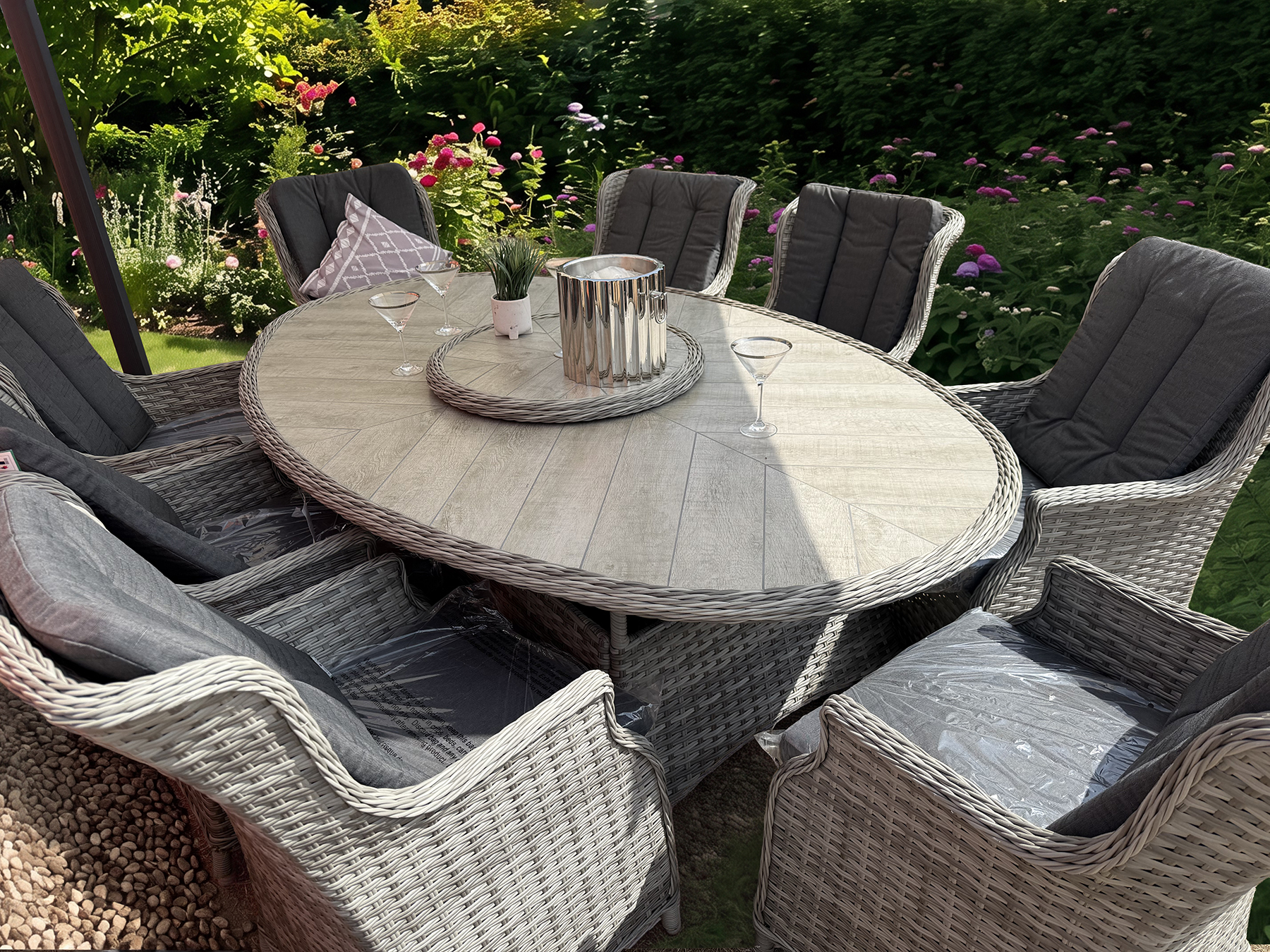
Rattan sets sold for gardens are designed around an assumption that quietly falls apart in commercial use: that someone brings the cushions in.
In a domestic garden, a set gets used perhaps forty days a year, gets covered in October, and has an owner who notices when a strand snaps. In a holiday let it gets used by fifty different households who have no reason to care. In a pub garden it’s out in all weather from March to November, gets sat on in wet clothes, and has cigarettes near it. Same furniture, entirely different demands.
None of that makes rattan a bad choice commercially. It’s light, it’s genuinely weatherproof at the frame and weave, it looks considerably better than plastic, and guests like it. But the specification decisions that matter are different from the ones a domestic buyer worries about, and there are a couple of points that catch people out. This is what to think about before ordering.
Start with the actual usage pattern
The single most useful thing you can do before choosing anything is to write down how many days a year the furniture will be in use, and who takes responsibility for it at the end of each day.
- Holiday let, changeover Fridays. Perhaps 200 occupied days a year. Nobody covers anything. Cushions live outside or in a box, depending entirely on whether the last guest could be bothered. Cleaner has 20 minutes for the outside space.
- Pub or café garden. 250 trading days, heavy use on maybe 60 of them. Staff bring cushions in nightly if you make it easy and don’t if you don’t. Furniture gets moved constantly.
- Communal courtyard, flats or offices. Low intensity, no supervision, no ownership. Nobody is responsible, which is its own category of problem.
- Wedding or events venue. Intense use in bursts, long dormant periods, high expectations on appearance.
Those four are different products. A holiday let can use domestic-grade furniture if the cushion problem is solved. A pub garden mostly can’t.
Cushions are the whole problem
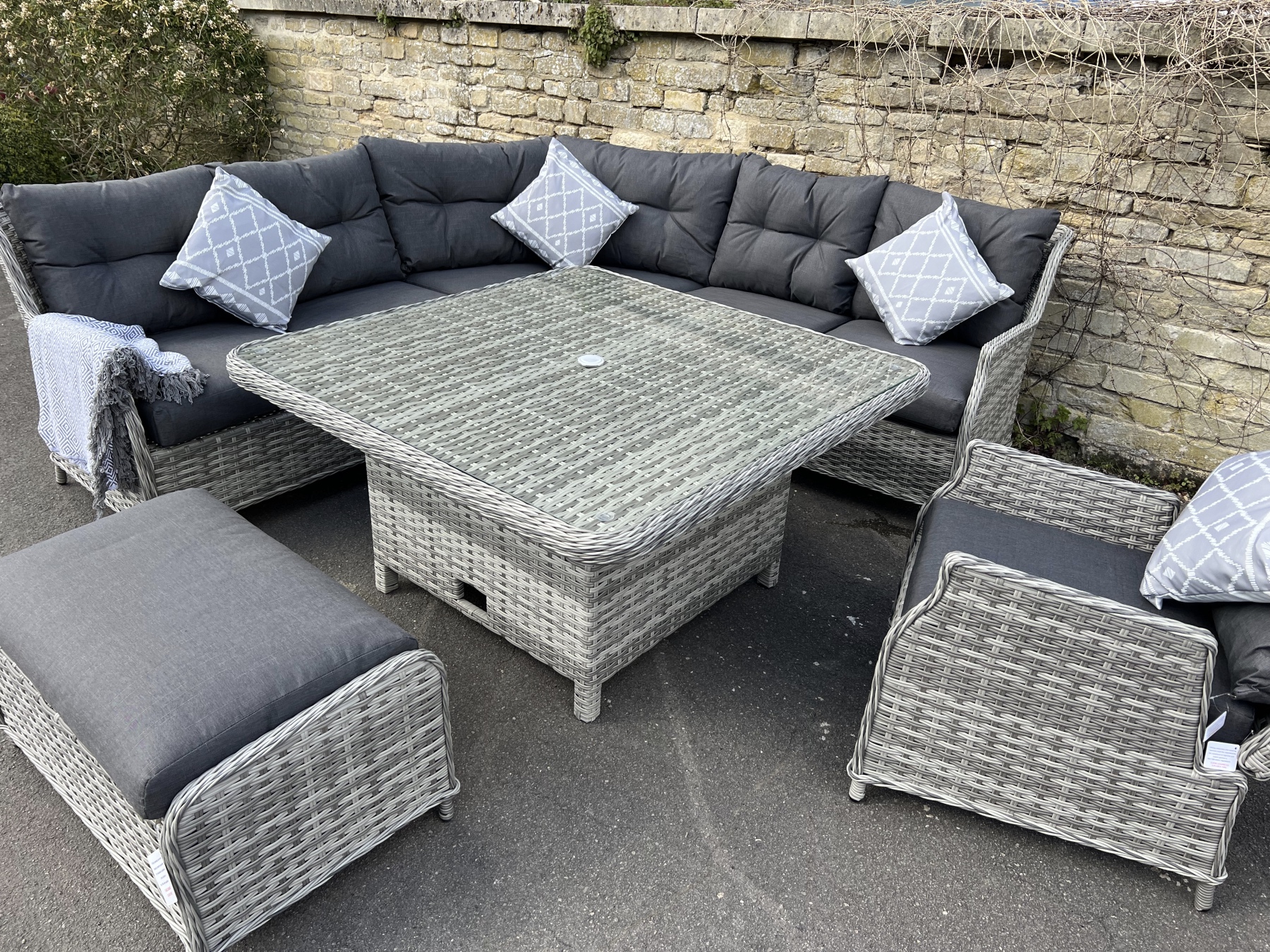
Everything else on a rattan set lasts. The powder-coated aluminium frame and the HDPE weave on a decent set are good for a decade outdoors. Our premium rattan corner sofa set uses hand-woven high-density polyethylene over a powder-coated aluminium frame, laboratory-tested between minus 20 and plus 60 degrees, with high UV resistance. That structure will still be sound long after the cushions have been replaced twice.
The cushions are where commercial use bites, for four reasons.
Nobody puts them away. The domestic care model assumes cushions come indoors when it rains and go into storage in winter. In commercial use that happens irregularly at best. A cushion that spends 200 nights outdoors will not perform like one that spends 40.
Water-resistant is not waterproof. Season-proof, water-resistant covers shed rain and dew. They are not designed to be sat on while soaking, then sat on again the next morning without drying. Water eventually reaches the fill, and a fill that stays wet grows mould from the inside.
Fill type decides everything. Standard closed-cell or fibre fill holds water. Quick-dry or open-cell reticulated foam is designed to drain through and dry, which is what commercial hospitality specification uses. If a set is going into genuine commercial service, ask what the fill is before you order. It’s the specification question most likely to save you money and least likely to be answered on a product page.
Cigarettes. In a pub garden, cushion covers get burned. Not maliciously, just constantly. Dark covers hide the marks, pale ones don’t, and no cover is immune.
Practical answers, in rough order of effectiveness:
- Buy replacement cushion covers at the same time as the set, not two years later when the weave colour and fabric batch have moved on
- Specify a cushion box or bench near the seating so putting cushions away takes ten seconds rather than a trip indoors
- Consider running the set cushion-free in shoulder season and only bringing cushions out on trading days that justify it
- For pub gardens specifically, budget for annual cushion replacement rather than treating it as a failure when it happens
The legal points nobody mentions
What follows is general information rather than legal advice, and the primary sources are linked so you can check them against your own situation.
Fire risk assessment applies to the outside space too. The Regulatory Reform (Fire Safety) Order 2005 requires a fire risk assessment for holiday accommodation and for common areas of let properties. Outdoor furniture matters to that assessment in two ways: whether it obstructs an escape route, and what sits next to it. Which leads directly to the next point.
Fire pits and heaters need thinking about separately. Rattan fire pit sets are popular and they photograph brilliantly. In a commercial setting they bring in questions about your insurance, your licence conditions, supervision, and the clearance between a heat source and a synthetic weave that is, ultimately, a plastic. Talk to your insurer before you buy, not after. If they’re not comfortable, they’ll tell you plainly and you’ll have saved yourself a large purchase.
Guarantees usually assume domestic use. Our premium rattan set carries a three-year guarantee. Manufacturer guarantees across this whole product category are generally written with domestic use in mind, and commercial use may fall outside them. This is not a rattan-specific point, it applies to almost all garden furniture, and it is worth confirming in writing before ordering for a business rather than assuming. If you’re buying for commercial use, get in touch and ask directly what the terms are for your situation.
Theft, weight and things walking off
A rattan corner sofa section is light. That’s an advantage when your staff rearrange the garden and a liability at two in the morning.
Aluminium-framed rattan weighs a fraction of what teak does. A single teak bench is genuinely awkward for two people to carry any distance. A rattan armchair is a one-person lift. In an unsupervised communal courtyard, or a pub garden with street access, that difference matters.
Options, none of them perfect:
- Weight it. Some operators fill or ballast the frame feet. Check this won’t invalidate anything before you start drilling.
- Anchor it. Ground anchors work well for fixed layouts and remove the flexibility that made you choose modular in the first place.
- Bring it in. Practical for a small terrace, not for a forty-cover garden.
- Accept the risk and insure for it. Often the honest answer, particularly for lower-value sets.
- Buy heavier furniture for exposed positions and rattan for supervised ones. A mixed specification is usually smarter than a uniform one. Teak dining sets in the exposed street-facing area, rattan lounge seating in the enclosed courtyard.
Modular sections: an advantage and a headache
Our premium corner set comes as three free-standing sections plus an armchair and stool. Commercially, that cuts both ways.
The advantage is real flexibility. Two sections face each other for a group of six, split apart for two groups of three, close into an L against a wall on a quiet Tuesday. For a venue with variable party sizes, that’s worth a lot, and fixed bolted seating can’t do it.
The headache is that guests do the rearranging themselves and don’t put it back. Sections drift, gaps open up, and by Saturday evening the garden looks like it’s been burgled. Some operators clip or bracket sections together to remove the option. Others build the reset into the closing routine and treat it as thirty seconds of work.
There’s an accessibility dimension too. If sections migrate, the clear routes through the space migrate with them. For any communal or public-facing space, decide what the fixed circulation routes are and mark or plan the layout so those don’t get squeezed. A garden that works when you set it up in the morning and doesn’t by lunchtime is a real problem, not a cosmetic one.
Cleaning, and what not to do
Rattan weave traps everything. Crumbs, ash, leaves, pollen, spilled drinks. In a domestic garden that’s a monthly nuisance. On a Friday changeover it’s a twenty-minute job someone doesn’t have twenty minutes for.
What works:
- A soft brush and warm soapy water remains the correct method, exactly as it is domestically. The commercial adaptation is doing it more often and more systematically rather than doing it differently.
- A brush attachment on a vacuum clears loose debris from the weave far faster than brushing, which matters when you’re doing eight sets.
- Between-guest routine. Build the outdoor space into the changeover checklist explicitly. If it’s not on the list it doesn’t happen.
What doesn’t work:
- Pressure washing. It forces water into the frame through gaps in the weave, drives dirt deeper into the strands, and can lift or break strands entirely. It’s the single most common cause of avoidable damage to synthetic rattan in commercial settings, precisely because it looks like the efficient option.
- Bleach and solvent cleaners. They degrade PE and take colour out of it. Whatever they’ve cleaned, they’ve shortened the life of.
- Leaving cushions face-down to “keep them dry”. They don’t dry, they trap moisture against the deck.
Our general guidance on looking after rattan through winter applies to commercial settings too, with the caveat that most commercial operators can’t follow the storage advice and should compensate with covers and cushion management instead.
Buying spares up front
This is the piece of advice most likely to save a commercial buyer money, and it costs nothing to act on.
Weave colour and cushion fabric shift between production runs. Not dramatically, but enough that a replacement section bought two years later can be visibly a slightly different grey next to the originals. Cushion fabrics get discontinued faster than furniture does.
So when specifying for a business:
- Buy at least one spare cushion set per seating group at the point of purchase
- If the layout is likely to expand, buy the extra sections now rather than later
- Ask about parts availability, particularly feet, glides and table fittings, which are the small components that fail and are hardest to source afterwards
- Keep the product references and order details somewhere findable in three years
For a domestic buyer that’s over-cautious. For a venue where a mismatched section is a visible fault every trading day, it’s straightforward planning.
Space, covers and layout
Commercial layout is a different calculation from domestic, because you’re planning for covers rather than for a family.
Our premium corner set needs 2.5m x 2.5m for the sofa alone, or 3m x 3m including the armchair. That seats five or six comfortably. In a pub garden context, that’s roughly the footprint of two four-cover tables, which is a useful comparison to make honestly when deciding how much of the garden goes to lounge seating.
Lounge seating generates lower covers per square metre than dining seating and generally longer dwell times and higher drinks spend. That’s a commercial judgement rather than a furniture one, but the furniture decision follows from it, so make the commercial call first.
On covers, the practical position is that most commercial operators don’t use furniture covers on a daily basis and shouldn’t pretend they will. Where covers genuinely earn their place is over the closed season, and there tailored covers on a set left in situ from November to March are worth having. Get the fit right, because a cover that pools water or traps moisture against cushions does more harm than none at all.
If you have awnings or a veranda, the calculation changes again, and our note on caring for commercial outdoor furniture under awnings and verandas covers the specifics. Furniture under permanent cover ages very differently, and generally better.
Cost per seat per year, not cost per set
The number that matters commercially is not the purchase price.
Take the full cost of the set, add expected cushion replacements over the period, divide by the number of seats and the number of years you realistically expect to keep it. A set that costs half as much and lasts a third as long is more expensive, and a set with cushions that need replacing every season may cost more over five years than one that costs considerably more up front.
Run that calculation over five years for two or three candidate options before deciding. It usually produces a different answer from the one the purchase prices suggest, and it’s the argument to make to whoever signs off the spend.
Where rattan isn’t the right answer
Being honest about this is more useful than selling into every situation.
Very high-traffic dining. For a garden turning tables all day, teak or metal dining furniture handles the abuse better and doesn’t have a cushion dependency. Our commercial outdoor furniture range and the commercial buyer’s guide are the better starting point there.
Anywhere the furniture must stack. Rattan sofa sets don’t stack. If your operating model involves clearing the garden nightly into a store, that rules out lounge seating almost entirely.
Unsupervised public spaces. Communal courtyards with no ownership and no supervision are hard on any furniture, and rattan’s light weight makes it an easy target.
Large volume orders. With nine rattan products in the range, a substantial multi-site specification is better served by the commercial route, where volume, lead times and consistency across a project can be planned properly.
Where rattan does work well is holiday lets, boutique accommodation, hotel terraces, enclosed courtyard gardens, and the lounge corner of a pub garden rather than the whole of it. Guests respond to it, it photographs well for listings, and the frame and weave genuinely last if the cushions are managed.
The full range sits in rattan garden furniture, with sofa sets and dining sets listed separately. For larger projects or anything where guarantee terms and lead times need agreeing in advance, the commercial side is the right place to start, and our guide to which commercial garden furniture suits which business covers the wider material choice.