🎉 Exciting News! Start with just a 10% deposit and choose a delivery date in 2026 to pay the rest. Flexibility made easy!

Double-Sided vs. Single Canopy: Choosing The Right Cantilever Parasol

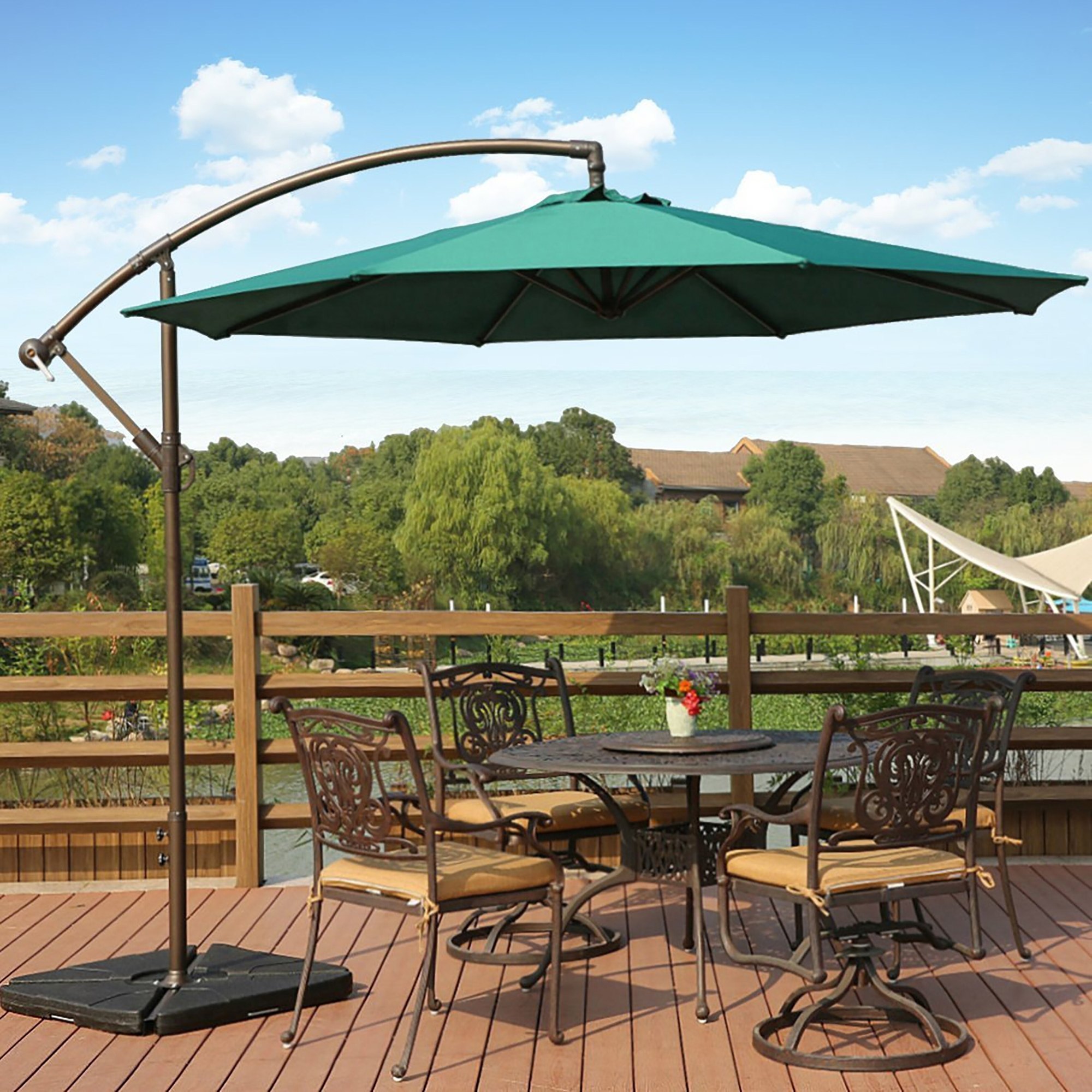
Shade is not merely a luxury in the garden; it is an engineering requirement. When you invest in a premium teak or rattan dining set, you are creating a destination. However, that destination becomes uninhabitable the moment the midday sun hits its peak, or worse, when the low-angle evening sun creates unbearable glare during dinner.
The solution is a high-performance parasol. But for years, customers have been stuck with a binary choice: the small, traditional “market umbrella” that goes through the hole in the table, or the complex, industrial-grade shade structures used by hotels.
Today, the landscape has changed. Homeowners now have access to two heavyweights of the shade world: the Single Canopy Cantilever (often with advanced rotation) and the architectural giant known as the Double-Sided Parasol.
Both offer massive coverage, but they solve different problems. In this deep dive, we will strip away the marketing language and look at the mechanics, the wind dynamics, and the spatial geometry of these two systems to help you decide which one belongs on your patio.
The Geometry of Shade: Defining the Contenders
Before we analyze which is better, we must define the structural differences, as these dictate how you will use your garden.
1. The Single Canopy Cantilever (The “Offset” Specialist)
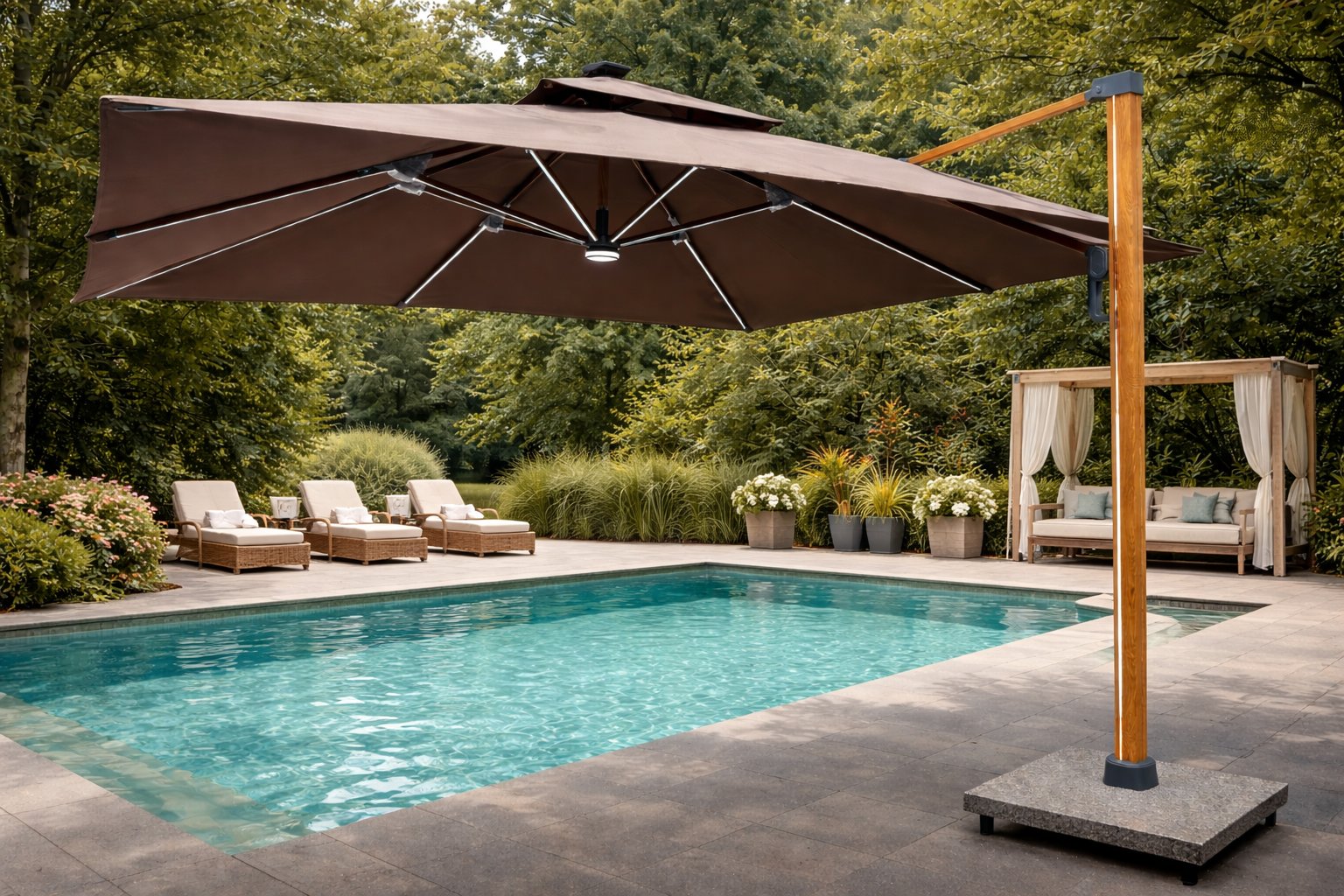
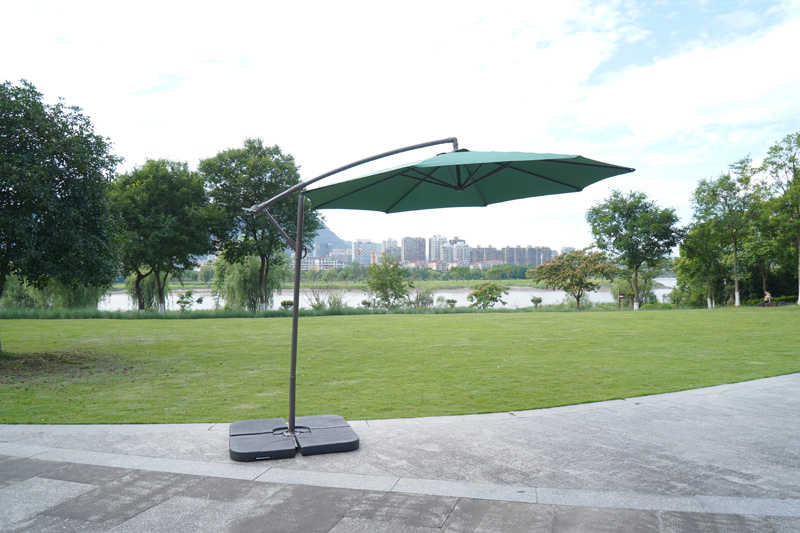
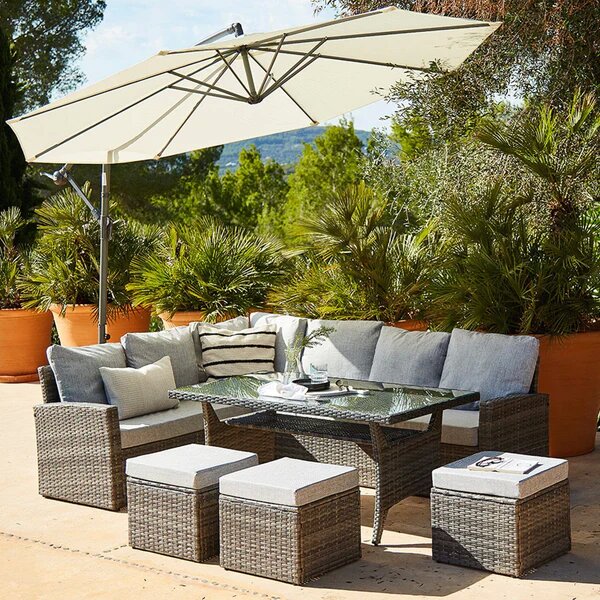
The defining feature of a cantilever, such as our 3m Aluminium Cantilever Parasol, is the offset pole. The mast sits to the side of the furniture, not in the middle. An overhead boom arm suspends the canopy over your seating area.
-
Key Advantage: Unobstructed space. You can talk to the person across the table without staring at a wooden pole.
-
Key Mechanism: 360-degree rotation and vertical tilt.
2. The Double-Sided Parasol (The “Banquet” Master)
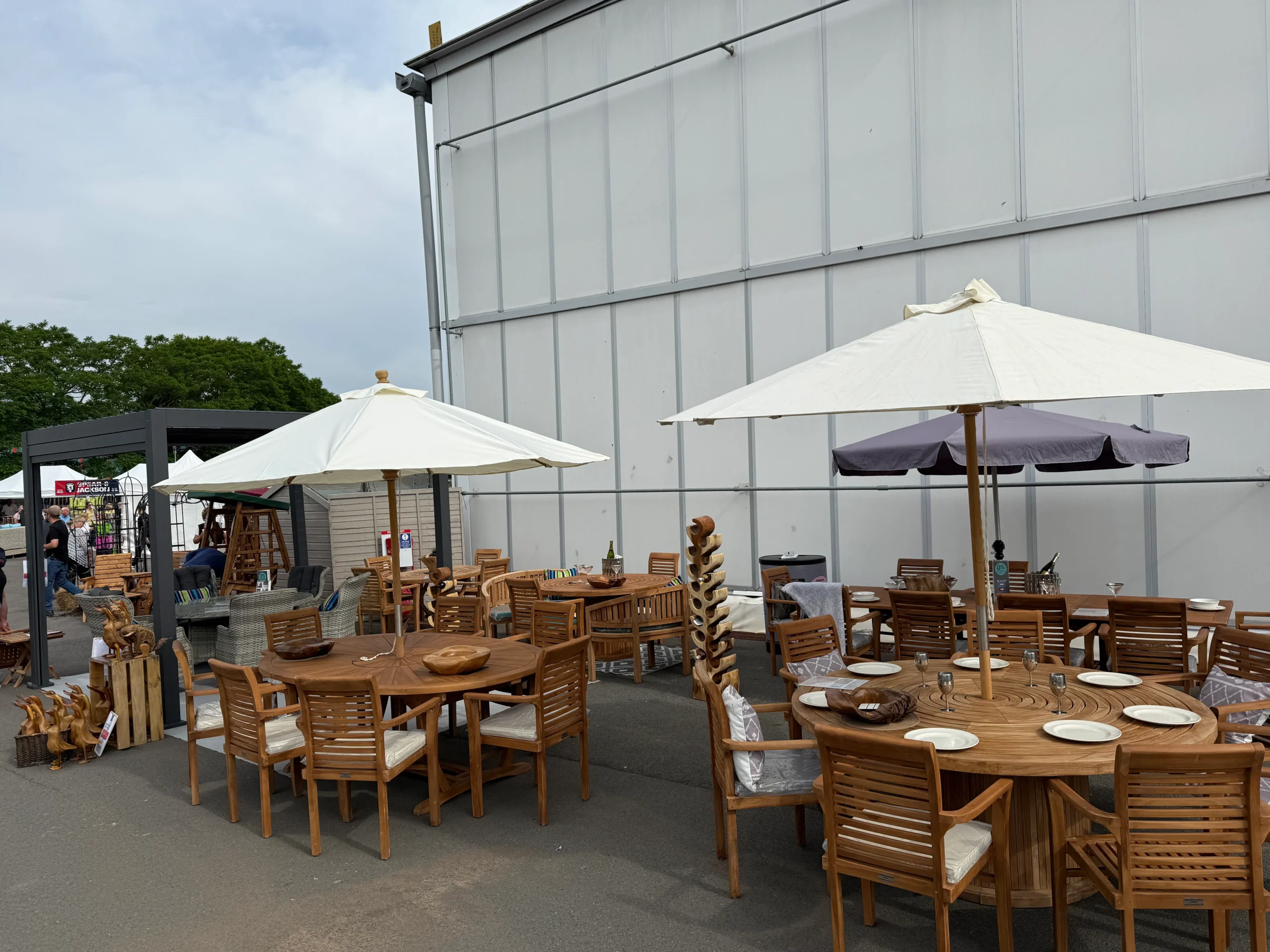
This is a beast of coverage. Our Beige Double-Sided Parasol (4.5m x 2.7m) essentially mounts two large canopies onto a single central mast structure. It creates a massive rectangular footprint of shade that mimics the shape of a roof.
-
Key Advantage: sheer volume of shade. It covers a length that a single round parasol simply cannot touch.
-
Key Mechanism: A high-torque crank handle system for rapid deployment.
Scenario 1: The “Long Table” Dilemma
This is the most common issue we see with customers who have purchased our 10-Seater Rectangular Extending Teak Tables. These tables can extend up to 3 meters in length.
The Failure of the Single Round Canopy
If you place a standard 3m round cantilever over a 3m long rectangular table, you have a geometry problem. A circle cannot fully cover a long rectangle. The guests sitting at the “Heads” of the table (the far ends) will be fully exposed to the sun. You end up with a situation where the middle of the table is in shadow, but the edges are roasting.
The Double-Sided Solution
This is where the Double-Sided Parasol is the only logical engineering choice. Its dimensions are 4.6 meters wide by 2.7 meters deep.
Because it creates a long, rectangular shadow, it mirrors the shape of your extending table. It provides edge-to-edge coverage. Whether you are sitting in the middle or at the very end of the table, everyone gets the same level of UV protection. If you host large family gatherings, Christmas dinners in July, or BBQs with 10+ people, the Double-Sided unit is the superior tool.
Scenario 2: The “Chasing the Sun” Problem
The sun is a moving target. In the UK, the sun rises in the East, arcs high in the South, and sets in the West. A static shade structure works for about two hours a day. For the rest of the time, the shadow is cast onto the grass, not your furniture.
The Static Nature of Double-Sided
The Double-Sided parasol is immense, but it is generally static. Due to its sheer size and weight, it does not typically rotate. It is a “set and forget” structure. It relies on its massive size to block the sun; if the umbrella is big enough, the angle of the sun matters less. However, in late evening, low sun might creep underneath the canopy edge.
The Agility of the Single Cantilever
This is where the 3m Aluminium Cantilever Parasol shines. It is designed for active shade management.
-
360-Degree Rotation: By depressing a foot pedal on the base, you can spin the entire canopy. In the morning, you angle it to cover your breakfast bistro set. In the afternoon, you spin it 180 degrees to cover the loungers.
-
Vertical Tilt: As the sun drops low in the evening (the “golden hour” glare), a standard umbrella becomes useless. Our cantilever models allow you to tilt the canopy vertically, turning it into a screen or shield against the horizon sun.
Verdict: If your patio has multiple zones (e.g., a dining area next to a sofa area), the Single Cantilever is the versatile winner. You buy one parasol, but it services two “rooms.”
The Physics of Stability: The Base Weight Requirement
We cannot discuss these large parasols without addressing the most critical safety factor: Anchoring.
A parasol is, aerodynamically speaking, a sail. When you open a 3m or 4.5m canopy, you are deploying a massive surface area that wants to catch the wind.
The Fulcrum Effect on Cantilevers
A Single Cantilever is inherently unbalanced. Because the weight of the canopy hangs off to one side, the center of gravity is not over the main pole. This creates a massive amount of torque at the base.
Standard plastic bases filled with water are rarely sufficient for high-quality cantilevers. They flex and wobble.
We strictly recommend—and often require—the use of our 100kg Polished Marble/Granite Base with Wheels.
-
Why 100kg? You need this mass to counteract the leverage of the boom arm.
-
Why Wheels? Moving 100kg of stone is impossible for one person. Our base features heavy-duty castor wheels (often with brakes), allowing you to glide this massive anchor across your patio.
The Center of Gravity on Double-Sided
The Double-Sided parasol has a central pole. This means the weight is distributed evenly straight down. While it is heavier overall, it is not fighting gravity in the same way a cantilever is.
However, due to the 4.5m width, the “uplift” risk from wind is higher. A sudden gust can try to lift the whole unit vertically. Therefore, while it is physically balanced, it still demands a heavy base—usually bolted or heavily weighted with sandbags or slab weights—to keep it grounded during a breeze.
Lighting and Ambiance: The Day-to-Night Transition
Modern garden furniture usage extends well past sunset. This is where technology integration becomes a deciding factor.
Our 3m Aluminium Cantilever Parasol with Solar LED Lights represents the new generation of smart furniture.
-
Integrated Strips: The LED lights are built directly into the ribs of the umbrella. This provides a soft, downward-facing glow that illuminates your table without blinding your guests.
-
Solar Autonomy: There are no trailing wires to trip over. A solar panel on the apex of the canopy charges a battery during the day.
-
The Atmosphere: This turns the parasol into a “ceiling” for your outdoor room. It creates intimacy.
The Double-Sided parasols, due to their vast size and simpler folding mechanisms, rarely come with integrated lighting. To light a table under a Double-Sided unit, you usually need external table lamps or string lights, which can be less elegant.
Material Science: Aluminium vs. Steel vs. Wood
When browsing our accessories category, you will notice different materials used for the frames. This is not just aesthetic; it is about longevity in the British climate.
Aluminium (The Cantilever Standard)
We predominantly use powder-coated aluminium for our Cantilever Parasols.
-
Rust Proof: Aluminium oxidizes, but it does not rust. If the paint gets scratched, the metal underneath protects itself. This is vital for UK coastal homes where salt air devours steel.
-
Weight: It is lightweight but has high tensile strength, making it easier to operate the crank handles and tilt mechanisms.
Steel (The Heavy Duty Option)
Some larger Double-Sided units use steel ribs because the span (4.6m) requires immense rigidity. Steel is stiffer than aluminium. However, it must be kept painted. If the powder coating chips, rust will set in.
The Fabric Factor: PA vs. PU Coatings
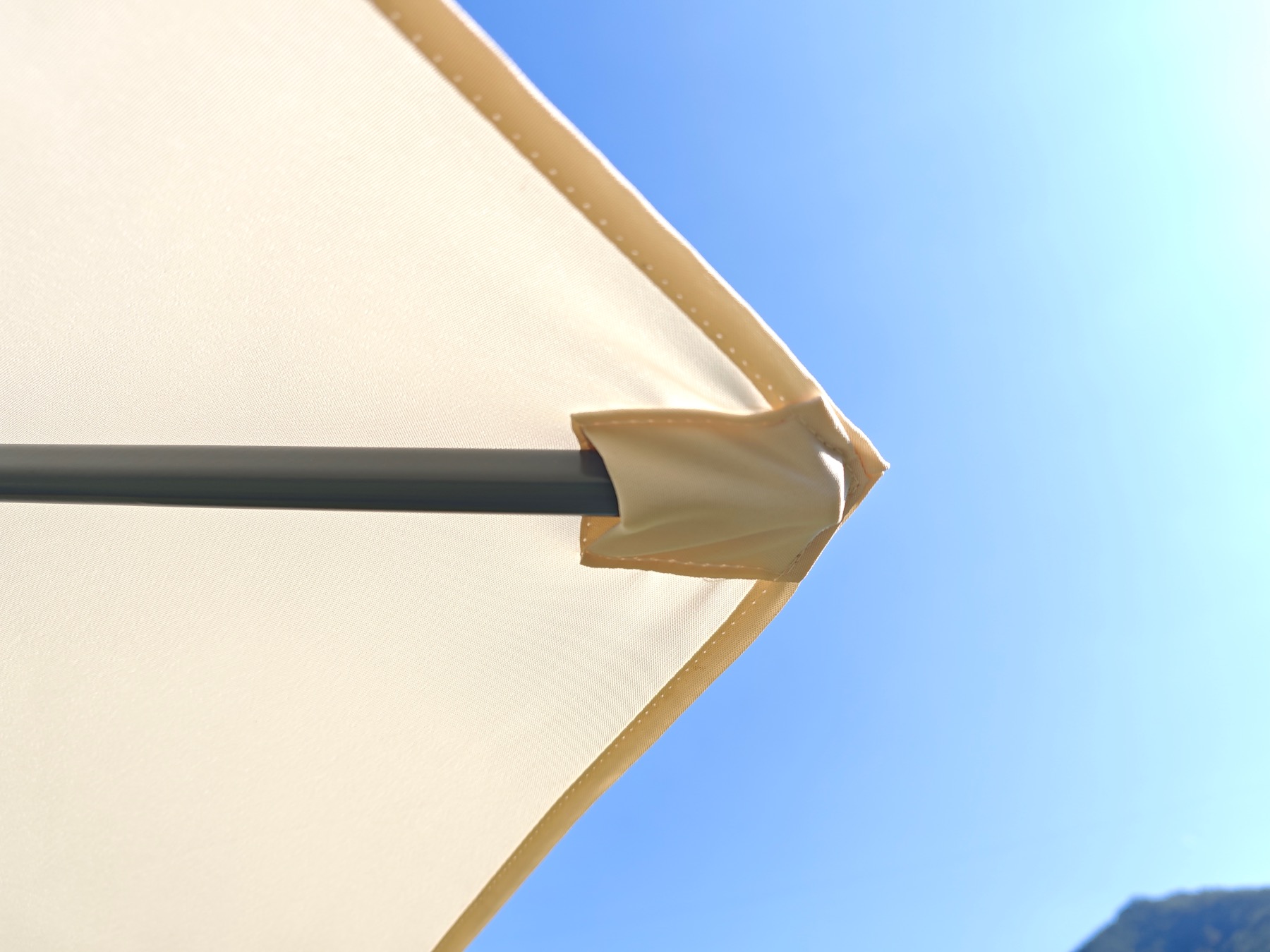
The canopy material itself is usually 180g to 230g Polyester. But the secret lies in the coating.
-
PA (Polyamide) Coating: Often used on our premium ranges. It offers excellent water resistance and, crucially, allows the fabric to “breathe” slightly, preventing hot air from getting trapped under the canopy (the greenhouse effect).
-
UV Protection: Both styles offer UV protection, but darker colours (Grey, Navy) will naturally block more glare than Beige or Cream, though Beige (like our Double-Sided model) is better for hiding bird droppings and tree sap stains.
Mechanical Durability: Cranks, Pulleys, and Pistons
How long will it last? This depends on the number of moving parts.
The Cantilever Complexity:
A cantilever is a complex machine. It has a winding crank, a vertical slide pistol grip, a rotation pedal, and internal wire cabling. While we engineer these to high standards, they require maintenance. You must lubricate the joints with a silicone spray annually. If you force the mechanism against the wind, you can snap the internal cord.
The Double-Sided Simplicity:
The Double-Sided parasol is mechanically simpler. It usually operates on a single heavy-duty crank handle that pushes the hub upwards. There is no tilt, no rotation, and no slide. Fewer moving parts generally mean fewer things to go wrong over 10 years. If you are looking for “bomb-proof” durability for a commercial setting (like a pub garden) or a high-traffic family home, the Double-Sided unit is often the more robust workhorse.
Wind Management: When to Close?
We must be honest about wind. No parasol, regardless of price, is designed to withstand a gale.
The Sail Effect:
-
Cantilever: Because it hangs from a top boom, a cantilever has a little bit of “swing” built in. It can absorb a light gust by swaying. However, in strong wind, this swaying becomes violent.
-
Double-Sided: This is a giant kite. If the wind gets under the 4.6m canopy, the upward force is immense.
The Golden Rule:
Both types feature an “air vent” at the very top. This allows heat to escape and, more importantly, allows wind pressure to release without lifting the canopy.
However, if the wind is strong enough to knock over a wine glass, the parasol must be closed.
-
Cantilever Advantage: It takes seconds to wind down and strap to the main pole.
-
Double-Sided Disadvantage: Closing a 4.6m wide umbrella can be physically demanding for shorter people, as the canopy is high and heavy.
User Case Study: Which One Are You?
To help you finalize your decision, locate yourself in one of these three profiles:
Profile A: The Lounge Lover
-
Furniture: A Corner Rattan Sofa Set or a couple of Sun Loungers.
-
Goal: You want to relax, read a book, or have a coffee. You move around the patio depending on the time of day.
-
Recommendation: 3m Solar LED Cantilever. The ability to rotate the shade to follow you is essential. The lights extend your reading time into the evening. The lack of a central pole means you can position the base behind the sofa, hovering the canopy perfectly over your lap.
Profile B: The Banquet Host
-
Furniture: A 10-12 Seater Teak Extending Table.
-
Goal: You host Sunday roasts, birthday parties, and Christmas dinner outdoors. You need to cover a lot of people at once.
-
Recommendation: Double-Sided 4.5m Parasol. You need the span. A single cantilever will leave your guests at the ends squinting in the sun. The central pole is not an issue because it sits in the middle of the large table (provided your table has a hole, or you use a split-base system).
Profile C: The Small Patio / Balcony
-
Furniture: A 4-seater round set.
-
Goal: Space saving.
-
Recommendation: Neither. Both of these are large-footprint items. A standard 2.5m market parasol is better. However, if you must choose, the Cantilever is better because the base can be placed off the patio (on the grass or decking edge), hovering the canopy into the space, effectively increasing your usable floor area.
Trustworthiness
When buying from a specialist like Teak Garden Furniture Outlet, rather than a general supermarket, you are buying into a support system.
Large parasols are serviceable items. Over five years, a rib might get bent in a storm, or a canopy might need cleaning.
-
Canopy Replacement: Both our Double-Sided and Cantilever models allow for the fabric canopy to be removed (usually via zipper or screw pockets). This means you can wash it to remove algae or replace it entirely without buying a new frame.
-
Base Compatibility: We ensure that our 100kg Marble Bases are universally compatible with our cantilever poles, ensuring you never have a “loose fit” which is the primary cause of damage.
Conclusion
The choice between a Double-Sided and a Single Canopy Cantilever is a choice between Volume and Versatility.
Choose the Double-Sided Parasol if you have a massive dining table and need to guarantee shade for 10+ people simultaneously. It is the blunt instrument of the shade world—effective, imposing, and structurally simple.
Choose the Single Canopy Cantilever if you want a refined, adjustable, and smart living experience. If you want to chase the sun, create an intimate evening atmosphere with LED lights, and keep your floor space clear of poles, this is the precision engineering choice.
Whichever you choose, remember that the parasol is only as good as its anchor. Do not compromise on the base. A 100kg marble base is not an optional extra; it is the foundation of your safety and the guarantee that your investment will stand tall for years to come.