🎉 Exciting News! Start with just a 10% deposit and choose a delivery date in 2026 to pay the rest. Flexibility made easy!

Garden Furniture That Works as You Get Older: Seat Heights, Arms and Weight

Most garden furniture is designed and photographed for people in their thirties. Nothing wrong with that, except that the person who spends the most time sitting in a garden is often retired, and a good deal of what gets sold makes that harder than it needs to be.
Three things decide whether a garden seat stays usable: how high the seat is, whether there are arms to push up from, and how heavy the piece is. This article works through those in order, then goes through our range piece by piece and says plainly which pieces suit and which don’t.
The short answer
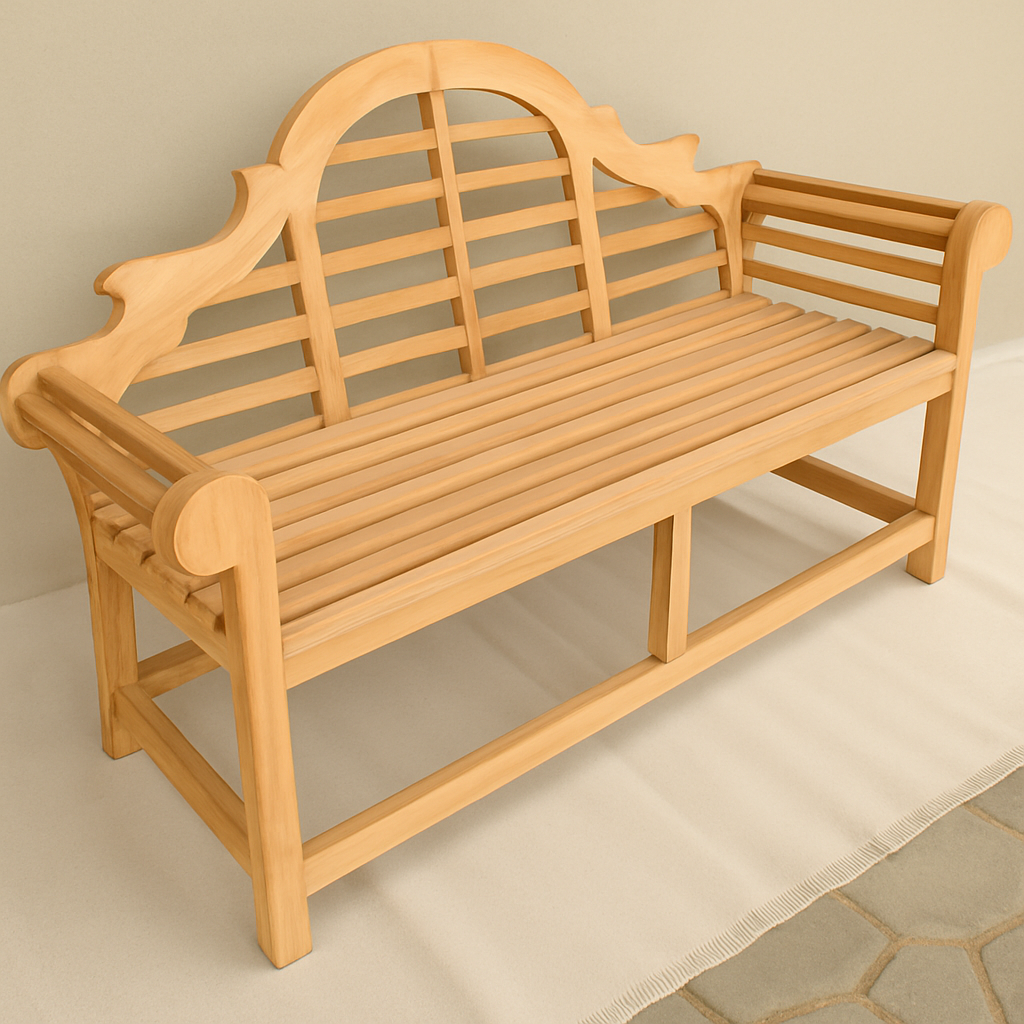
If you want the recommendation without the reasoning, it’s the Lutyens Teak Garden Bench at £350. Scrolled arms at both ends, a high curved back, solid teak that won’t shift when you lean on it, and minimal assembly. It’s the piece in our range best suited to someone who finds getting up a bit of an effort, and it happens to be one of the nicest things we sell.
For dining, the answer is the Teak Bench at £348, which has a published 45cm seat height, paired with a bench cushion to bring the effective height up to around 50cm.
The rest of this explains why, and covers what to avoid.
Start with seat height, not style
Getting out of a chair takes effort roughly in proportion to how far your body travels and how much your knees bend to begin with. A low seat means deeper knee flexion at the start, which asks a lot more of the thigh muscles. Higher means less travel and less load.
This is measurable rather than a matter of opinion. Clinical mobility assessments such as the 30-second chair stand test standardise on a seat of around 43cm to 46cm precisely because height changes results so much. One study of community-dwelling older adults found that raising the seat above that standard produced significantly better sit-to-stand performance, and lowering it made things measurably harder.
There’s a limit at the other end. A seat that’s too high leaves feet dangling or forces you to shuffle forward before standing, which brings its own difficulties. The target is feet flat on the ground with knees at roughly a right angle, or fractionally above that.
Find your number in two minutes
- Sit on a firm dining chair wearing normal outdoor shoes.
- With feet flat, measure from the floor to the back of the knee at the crease.
- That’s your baseline.
For most adults it lands between 42cm and 48cm. If rising is easy, buy at the baseline. If it takes visible effort, add 10 to 15 per cent, which usually means somewhere around 48cm to 55cm.
Write the number down. It’s more useful than any product description, including ours.
Arms make the biggest single difference
If you change one thing on this list, change this one.
Arms give you somewhere to push from, which brings the shoulders and arms into a movement that would otherwise be entirely legs. They give you something to lower yourself onto rather than dropping the last few inches, which is where most garden furniture accidents actually happen. And they give you a handhold while turning to sit, which is the moment balance is least reliable.
What to look for:
- Arms running to the front of the seat.An arm stopping halfway along is decorative. You need a push point roughly above your hip when you’re already leaning forward.
- A solid, flat or gently rounded top.Narrow or sharply rounded arms are hard to grip and unpleasant to bear weight on.
- Around 20cm to 25cm above the seat.Lower and you can’t push effectively. Higher and the shoulder does the work at a bad angle.
- An arm that flexes under weight is worse than no arm, because you commit to something that gives. This is where joinery quality shows, and it’s why mortise and tenon construction matters here rather than just being a nice detail.
Our range, piece by piece
Lutyens Teak Garden Bench, £350
The best fit in the range for this purpose, and by a clear margin.
The scrolled arms run the full depth of the seat, so the push point is where you need it. The high curved back gives genuine support, which matters for a long sit rather than a perch. Solid teak with traditional joinery means it doesn’t move when you lean on it, which is the whole point.
The honest caveat: the middle seat has no arms. On a three-seater, two of the three seats work well for this and one doesn’t. If the bench is mainly for one person, that’s irrelevant. If it’s family seating, plan for who sits where.
We don’t currently publish the seat height on this product. If you’ve measured your number and want to check before ordering, ask us and we’ll measure the actual bench rather than quoting a range.
Teak Bench (Bowood curved bench), £348
155cm wide, 86cm high, 60cm deep, with a published 45cm seat height and 50cm seat depth. That seat height sits right on the clinical standard, which is why this bench works for most people without adaptation.
The 50cm seat depth is worth noting as a positive. Shallower seats let you sit back properly with feet still flat on the ground, which is the position you want to stand from. Deep seats leave you either perched forward or sitting back too far to rise easily.
The caveat: no arms. This is a bench in the traditional sense. It works well when positioned so there’s something solid to hand, against a wall, beside a table, or next to a sturdy planter such as our teak planters. It works less well standing alone in the middle of a lawn.
It also requires assembly, unlike the Lutyens, which is worth factoring in.
Teak Stacking Chair
95cm high, 52cm wide, 63cm deep, stacks up to four, mortise and tenon throughout. Cushions available in green and grey.
These are the chairs that come with most of our dining sets, and they’re a sensible dining chair. Being light, they’re easy to move and easy to stack away, and four stacked take up the floor area of one.
Two honest points. First, we publish overall dimensions rather than seat height on this chair. If seat height is your deciding factor, ask before you order. Second, light chairs move. A chair that shifts as you lean on the back of it to sit down is exactly the wrong behaviour. For someone who steadies themselves on furniture, a heavier fixed chair or a bench is the safer choice, even though the stacking chair is more convenient in every other respect.
The wider teak garden chairs category has nine products including armed designs. If you’re specifying a dining set for someone who needs arms, ask us to substitute armchairs throughout rather than accepting the usual arrangement of two carvers and the rest without, which puts the useful seats at the ends of the table and everyone else on the awkward ones.
Cushions: the cheapest adjustment available
A firm outdoor cushion of 5cm to 8cm raises effective seat height by roughly that amount once compressed. On the 45cm Teak Bench, that puts you at around 50cm to 52cm, which is squarely in the easier range.
- Cushion Green for Bowood Bench, £70
- Premium cushion, natural, for stacking chair, £25
- Cushion grey for stacking chair, £29.99
Two things matter. Compression beats thickness: a thick soft cushion may squash lower than a thin firm one, and the height you feel sitting on it is the height that counts. And cushions must not slide, because a cushion shifting while you push up on an arm is a hazard. Ours are cut to specific pieces rather than sold as generic squares, which is the difference between a cushion that stays put and one that ends up on the ground.
If you already own furniture that’s slightly too low, a firm cushion is a far better first move than replacing the set.
Dining tables
All our teak dining tables are 76cm high, which pairs correctly with seats around 45cm. Nothing to decide there, but two things to check.
Leg frames on extending tables. The extending tables have a frame beneath the top that eats into knee clearance, particularly at the ends. If someone needs their knees fully under the table to eat comfortably, check that specific seat position rather than assuming.
Round tables and the lazy susan. The 150cm round table with three Bowood benches has an 80cm lazy susan in the centre. That’s genuinely useful here: dishes come to you rather than requiring a reach across a 150cm table, which is a small thing that makes a meal easier for anyone with limited reach or shoulder movement.
For a smaller garden, the 100cm round table with 4 chairs at £399 keeps everything within easy reach and keeps the walking distances short.
Rattan Premium Large Corner Sofa Set
This is where we have to be straight with you.
The published dimensions tell the story: the corner sofa sections are 78cm and 86cm deep, and the armchair is 73cm deep. That is deep lounge seating. Deep, low seating is comfortable to sit in and genuinely difficult to get out of, because the seat sits well below dining height, the cushions compress under you so the effective height drops further, and you’re sitting a long way back from the front edge.
That isn’t a criticism of the set, which is a fine thing to have in a garden. It’s an argument for being clear about who it’s for. A rattan corner sofa is a poor choice as the only seating in a garden used by someone in their eighties.
Two things about this set do help, though, and they’re worth knowing:
It includes a reclining chair. A separate firm chair alongside the sofa means there’s always one seat that’s easy to leave.
The adjustable table goes from 48cm to 68cm. At 68cm it’s near dining height, which gives something solid and correctly placed to steady against. A 40cm coffee table does not. If you’re buying a lounge set for a garden where mobility is a consideration, a rise-and-fall table is the single most useful feature on it.
The set needs 2.5m x 2.5m for the sofa alone, or 3m x 3m including the chair, which is also worth knowing before it arrives.
Teak and aluminium sofa sets
The Corner Teak Sofa Set and the 4-Piece Aluminium Outdoor Sofa Set sit in the same category as the rattan set for this purpose. Lounge seating, comfortable, low. The teak version has the advantage of a firm timber arm to push from rather than a padded one, which is a real point in its favour.
The aluminium set is light, which is the double-edged property discussed below.
Parasols and pergolas
Shade is not a comfort extra here. A garden with no shade doesn’t get used in July, and a chair that doesn’t get sat in fails at its job regardless of how well specified it is.
One practical point about mechanisms: our teak parasols use a traditional pull-string system, which needs a firm single pull, while our aluminium and steel parasols at 2.7m use a crank, which needs a rotating wrist action but less force. Neither is ideal for weak hands.
If hand strength is a genuine issue, a fixed structure removes the problem entirely. Our aluminium pergolas go up once and need nothing doing to them thereafter, which is the real accessibility argument for a pergola over a parasol.
Weight pulls in two directions
The obvious answer here is wrong.
Light furniture is easy to move and easy to knock over. A lightweight chair can shift as you sit down or lean on it, which is precisely the wrong moment.
Heavy furniture is stable and hard to reposition. Solid teak doesn’t go anywhere when you lean on the back of it, which is exactly what you want. It also means it stays wherever it was left.
The right specification is usually heavy seating, light everything else. Stability where a person’s weight goes, manageability where it doesn’t. In our range that means teak benches and fixed chairs for the seating, and the folding picnic table or stacking chairs for the pieces that get moved.
If furniture has to go in and out of a shed seasonally, size it around the person doing the moving. Our large tables are a two-person lift and our delivery team will place a set, but won’t be back in October.
The things around the furniture
Surface. Chair legs sink into a lawn, and a chair sunk unevenly rocks. Gravel is worse, because legs shift and it’s an unstable surface to stand up onto. Hard, level ground under the seating is worth more than any feature of the furniture itself.
Route to the seat. Steps, thresholds and narrow gaps all matter. Leave a clear route wider than feels necessary, and keep it clear of pots and hoses.
Space behind the chair. A chair needs to come back far enough to stand without twisting. With our stacking chairs at 63cm deep, allow at least that plus room to stand.
Something solid at hand. A table edge, a wall, a heavy planter. Not a parasol, which will move, and not a light chair.
A checklist to take shopping
- Measure floor to back of knee, in shoes. Write the number down.
- Look for seats at that height or slightly above.
- Insist on arms that run to the front of the seat.
- Push hard on the arm. If it flexes, walk away.
- Sit down and stand up three times. Not once.
- Check seat depth allows sitting back with feet still flat.
- Lean on the chair back. Does it move?
- Check knee clearance at the seat they’ll actually use.
- Work out who moves it, how often, and whether they can.
- Plan the surface and the route.
Point five is the one people skip and the one that tells you most.
Choosing by situation
A garden used mainly by one older person. One Lutyens bench in the best spot, with a cushion and something solid beside it, beats a six-piece set nobody uses. Get the one seat right.
A family garden where grandparents visit. Mix it. Armed seating on one side of the table and at the ends, stacking chairs elsewhere. Nobody has to negotiate for the good seat if there are enough of them.
Planning ahead rather than solving a current problem. Buy at 45cm with arms in solid teak, and use cushions to raise the seat later as and when. That flexibility is the reason a good teak set outlives the circumstances it was bought for.
Where mobility is a real and current difficulty. Get advice specific to the person rather than working from an article. An occupational therapist can assess seat height and transfers properly, with referrals through a GP or local authority adult social care. Age UK can point you at local services. This piece covers furniture, not individual needs.
Questions we get asked
Why don’t you publish seat heights on every chair? Fair question, and we’re working on it. The Teak Bench has it listed at 45cm. Others show overall dimensions only. If seat height is your deciding factor, ask us and we’ll measure the actual piece before you order.
Should I just buy the highest seat I can find? No. Too high causes its own problems. Aim for your measured baseline, or 10 to 15 per cent above if rising is difficult.
Do chair raisers work outdoors? Indoor raisers assume level floors and specific leg shapes. A garden is neither. A firm cushion is the safer outdoor route. If raisers are genuinely needed, that’s a conversation for an occupational therapist.
Can I buy a dining set with armchairs instead of stacking chairs? Usually, yes. Get in touch with the set you’re looking at and we’ll tell you what the options are.
Is the Lutyens bench comfortable enough to sit on for an hour? With a cushion, yes. Slatted teak without a cushion is fine for twenty minutes and less generous after that, which is true of every hardwood bench ever made.
If you’ve got your number and want to check a specific piece against it, ask us rather than guessing from a photograph. We’d rather measure a bench for you than process a return.


